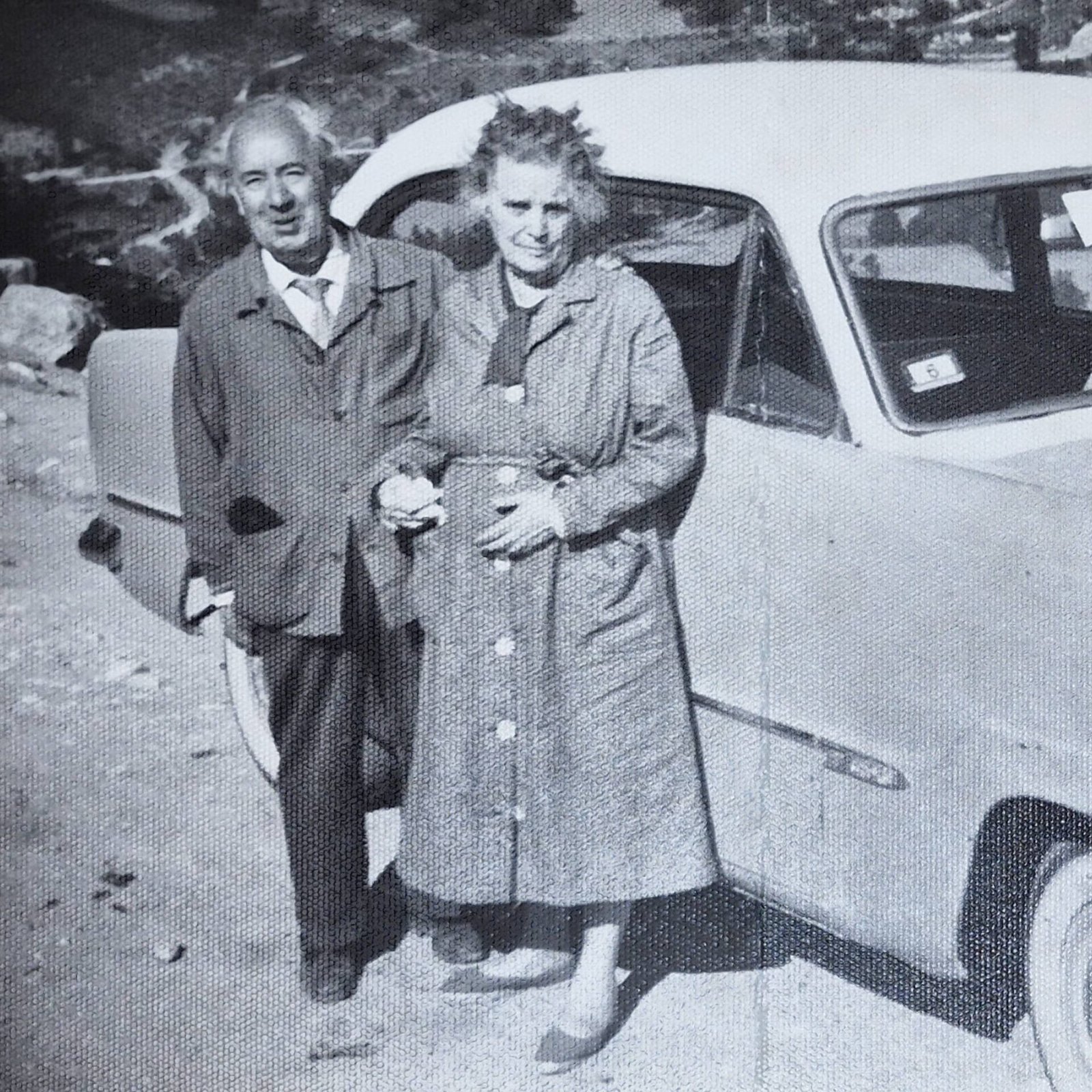
I’d like to share a small family story that lives on the walls of this house: the story of my uncle Paco.
Born in Madrid around 1900, he later met my aunt Victorina, a woman from La Rioja who was my grandmother’s sister. They married and, as far as I remember, they were happy, even though the times they lived through made things far from easy.
My uncle came from a well-off family that owned a chalet in Pozuelo — already a distinguished area back then — and a well-known shirtmaker’s shop on Calle Mayor, right in the heart of Madrid. As was expected of someone of his background, Paco studied at the Lycée Français and later followed his true calling by training in painting and sculpture at the prestigious Royal Academy of Fine Arts of San Fernando. In those years, studying art so deeply was a privilege only a very few could afford.
Then the Civil War broke out.
Since they were living in Madrid, the family experienced the conflict on the Republican side, whose ideals they shared. When the war ended, they found themselves on the losing side, and the consequences soon became painfully clear. My aunt Victorina, who was a schoolteacher, was banned from teaching and removed from the classroom; the new authorities would not allow a woman with Republican convictions to educate the next generation. My uncle Paco, who worked in the family shirtmaker’s shop, also saw his livelihood disappear when his parents were forced to give up the business.
From that moment on, their names were marked, and neither of them was ever allowed to officially return to their profession. Their lives became a daily exercise in dignity and quiet resilience. They got by as best they could: she gave private lessons to neighborhood children; he taught languages, restored small pieces of furniture, repaired fans, rescued paintings entrusted to him by clients, or sold his own oils and boards at the stalls of Madrid’s Rastro market.
Money was tight, and hardship became part of everyday life. That is why the whole family came together to help them discreetly: whenever there was a celebration or a special date, we would commission a work from my uncle Paco so he could earn a modest but dignified living from his talent. That is how, during my first fourteen years, one of my birthday gifts was always a painting made by him. My mother — and other relatives too — bought them to support him, and those paintings became part of the walls of my childhood and some of my dearest memories.
Thanks to that family pact of love, I now have a large collection of his paintings. However, the walls of a house have a physical limit, and many of these works do not have the space they deserve to be properly enjoyed.
Now that you are staying in our Madrid home through HomeExchange, we wanted it to serve as a small living gallery in memory of my uncle Paco. If, during your stay, one of his paintings speaks to you, I’d be delighted for it to become part of your home. We are not looking to make money from these pieces, but to give them a new home where they will remain loved and cared for. That said, we do not want to give them away for free: experience teaches us that what is received at no cost is rarely valued and can easily end up forgotten or thrown away within days.
For that reason, we ask for a symbolic contribution of twenty euros per painting. It is only a small amount, meant to honor my uncle’s work and to ensure that whoever takes a piece does so with the sincere intention of hanging it in their home, taking with them a genuine piece of art and a fragment of Madrid’s memory.
Practical note for your stay: if you’d like to take one of the paintings with you, just message me.
With all my heart, thank you.