🇪🇸 Leer este artículo en español
An essential Madrid food guide for visitors: traditional hearty dishes, classic tapas and historic taverns where you can experience the city’s most authentic flavours — with practical tips and easy public-transport access from Carabanchel.
Venues marked with 🚇⭐ have a quick, direct public-transport connection from the neighbourhood (Carabanchel).
The Proper Meal: Spoon Dishes and Tradition
These dishes are meant to be enjoyed sitting down for lunch, usually between 1:30 and 4:00 p.m. They are hearty and comforting, and they call for a relaxed meal followed by plenty of time for conversation.
Cocido Madrileño (Madrid-style chickpea and meat stew)
What it is and how to eat it: Madrid’s ultimate stew. It is served in three successive courses: first, a rich noodle soup made with the concentrated broth; second, tender chickpeas accompanied by sautéed cabbage, potato and carrot; and third, the meat — traditionally known as el viando — including beef shank, Iberian pork belly, chorizo, blood sausage, chicken and bone marrow.
Where to enjoy it:
🚇⭐ Malacatín (Calle de la Ruda, 5 – La Latina): An essential century-old tavern, with classic tiled walls, enormous portions served to share, and an authentic old-school Madrid atmosphere, just a direct Metro Line 5 ride away.
🚇⭐ La Bola (Calle de la Bola, 5 – Ópera/Palacio): Since 1870, each serving has been cooked individually in earthenware pots over glowing holm-oak charcoal embers. A living piece of Madrid’s history.
🚇⭐ Taberna de la Daniela (Plaza de Jesús, 7 – Las Letras; and Calle de Cuchilleros, 9 – Austrias, plus two other locations farther from the neighbourhood): A bullfighting-themed tavern decorated with traditional tiles, where the ritual of the three courses is carried out with precision and the broth is exceptionally clear.
🚇⭐ Posada de la Villa (Calle Cava Baja, 9 – La Latina): A former inn dating from 1642, now converted into a traditional grill restaurant. Its cocido is superb, served in an earthenware casserole in the heart of La Latina.
🚇⭐ Taberna Pedraza (Calle de Recoletos, 4 – Retiro/Salamanca): The pinnacle of contemporary technique. Tiny pedrosillano chickpeas, carefully skimmed broth and cured meats made from acorn-fed Iberian pork.
Practical tip: Booking several days in advance is essential. Treat this as your only meal of the day.
Callos a la Madrileña (Madrid-style tripe stew)
What it is and what to expect: A traditional offal dish made with beef tripe and veal foot, slow-cooked for hours with chorizo and artisanal blood sausage. The veal foot’s natural gelatin gives the sauce a thick, glossy texture that leaves your lips pleasantly sticky. It is not gamey or overly strong; instead, it has a fragrant, smoky and slightly spicy paprika flavour.
Where to enjoy them:
🚇⭐ Casa Enriqueta (Calle del General Ricardos, 19 – Marqués de Vadillo/Carabanchel): A historic temple of offal cooking in the district itself. This modest, unpretentious tavern has been preparing callos and other traditional dishes much as they were made sixty years ago.
🚇⭐ Casa Salvador (Calle de Barbieri, 12 – Chueca): A classic, traditional restaurant with its bullfighting-themed décor still intact, serving some of the city’s most canonical and highly regarded callos.
🚇⭐ Casa Ciriaco (Calle Mayor, 84 – Ópera/Palacio): A piece of Madrid’s history opposite Almudena Cathedral. Its traditional callos recipe is noted for the precise balance of paprika and the sauce’s rich, silky texture.
🚇⭐ Taberna La Bola (Calle de la Bola, 5 – Ópera): In addition to cocido, it serves classic, richly bound callos in a traditional earthenware casserole.
San Mamés (Calle de Bravo Murillo, 30 – Cuatro Caminos): Famous throughout Madrid for its exceptionally clean, smooth sauce, with very little grease and a perfect texture.
La Tasquería (Calle del Duque de Sesto, 48 – Salamanca/Retiro): For those looking for a fine-dining interpretation, where the recipe is refined to achieve remarkable elegance. The restaurant has helped elevate once-disregarded offal dishes to haute cuisine, earning a Michelin star and numerous awards and accolades.
Practical tip: Dipping bread into the sauce — known locally as hacer barquitos, literally “making little boats” — is an essential part of the ritual. If you are unsure about trying them, ordering half a portion to share is the best introduction.
Sopa de Ajo o Castellana (Castilian garlic soup)
What it is and what to expect: A monument to the humble cooking of Castile. It is made with day-old bread, thinly sliced garlic gently browned in good extra-virgin olive oil, sweet pimentón de la Vera, a flavoursome broth and diced ham. It is finished by cracking an egg into the pot, allowing it to poach gently in the residual heat. You may see this dish listed under either of two names — sopa de ajo or sopa castellana — but they refer to the same soup.
Where to enjoy it:
🚇⭐ La Cruzada (Plaza de Gabriel Miró, 7 – La Latina/Vistillas): One of Madrid’s oldest taverns, with a bar dating back to 1827. It serves a rich, velvety Castilian garlic soup with a deep ham flavour, cooked slowly.
🚇⭐ Casa Ciriaco (Calle Mayor, 84 – Ópera/Palacio): Served piping hot in an earthenware casserole, with the bread perfectly softened and a distinctive smoky aroma.
🚇⭐ El Mesón del Champiñón (Cava de San Miguel, 17 – Austrias): Although this area is very touristy, it still preserves historic taverns where garlic soup is prepared as a classic winter restorative.
🚇⭐ Posada de la Villa (Calle Cava Baja, 9 – La Latina): Made with the restaurant’s own cocido broth, which gives it a much fuller texture and rounder flavour than quicker versions.
🚇⭐ Restaurante Botín (Calle de Cuchilleros, 17 – Austrias): Listed by Guinness World Records as the oldest restaurant in the world; its wood-fired Castilian garlic soup is an absolute Madrid classic.
Practical tip: This is the ideal first course for restoring your energy after a morning of sightseeing, especially from October to April. It should be eaten piping hot — there is hardly a better dish for a cold day.
The Art of Tapas
Cultural note for visitors:
Madrid’s tapas culture is experienced standing at the bar, shoulder to shoulder with other customers. Traditionally, you do not order your entire meal in one place: you have a small draft beer or a glass of wine with the house speciality, then move on to the next tavern.
Pincho de Tortilla de Patatas (Spanish omelette)
What it is and what to expect: The everyday staple of Madrid life, enjoyed mid-morning or in the late afternoon. There are two main schools: the classic version, firmer and more evenly set, and the melosa style, with the egg barely cooked and almost runny. The onion question — with or without it — remains Madrid’s great local debate.
Where to enjoy it:
🚇⭐ Bodega La Ardosa (Calle de Colón, 13 – Malasaña): Historic tavern dating from 1892. Its San Sebastián-style tortilla, made with slowly cooked onion and a soft but contained centre, is legendary.
🚇⭐ Juana La Loca (Plaza de Puerta de Moros, 4 – La Latina): Famous for its juicy tortilla topped with crisp caramelised onion. A La Latina classic.
🚇⭐ Casa Dani (Mercado de la Paz, Calle de Ayala, 28 – Salamanca): Winner of numerous national competitions. Runny egg, tender potato and an unbeatable market atmosphere.
🚇⭐ Pez Tortilla (Calle Cava Baja, 42 – La Latina, and Calle del Pez, 36 – Malasaña): Specialists in freshly made, barely set tortillas with creative fillings.
🚇⭐ La Primera (Calle Gran Vía, 1 – Centro/Banco de España): Located at the elegant beginning of Gran Vía, with direct views of Calle de Alcalá and Plaza de Cibeles. It serves the celebrated Cañadío group tortilla, prepared Santander-style: carefully softened potato, deeply caramelised onion and a creamy, silky egg centre that holds its shape rather than spilling out. Ordering a pincho at its elegant bar while enjoying the light along Gran Vía is one of the most pleasurable experiences in central Madrid.
Practical tip: If you like a runny centre, ask for a tortilla that is poco cuajada or melosa — barely set or soft-centred. Ordering a pincho at the bar with a doble de cerveza, a larger draft beer, is the classic mid-morning ritual.
Oreja a la Plancha (grilled pig’s ear)
What it is and what to expect: One of the most traditional and beloved bites served at neighbourhood bars. The pig’s ear is boiled first and then cooked on a very hot griddle until golden and crisp on the outside, while remaining gelatinous and slightly chewy inside. It is usually dressed with chopped garlic, fresh parsley and a few drops of lemon, or covered with salsa brava.
Where to enjoy it:
🚇⭐ Cervecería Gonmar (Paseo de Muñoz Grandes, 47 – Carabanchel/Vista Alegre): The neighbourhood benchmark. Famous throughout the district for its crisp, deeply browned pig’s ear, excellent seasoning and genuinely welcoming local-bar atmosphere.
🚇⭐ La Oreja de Jaime (Calle de la Cruz, 12 – Sol/Huertas): A small central tavern devoted almost exclusively to this dish. It serves the ear very crisp, with a paprika-rich salsa brava.
Docamar (Plaza de Candelaria, 2 – Quintana): Although best known for its patatas bravas, it also does an excellent grilled pig’s ear, evenly browned and topped with its salsa brava.
🚇⭐ Casa Toni (Calle de la Cruz, 14 – Sol/Huertas): A traditional Madrid tavern that takes classic griddle cooking seriously; an ideal place to order pig’s ear and sweetbreads in an atmosphere free from tourist concessions.
Practical tip: For visitors who are hesitant about offal, the crisp texture produced by the griddle is often a very pleasant surprise. Ask for it bien pasada or crujiente — well done or extra crisp.
Bocadillo de Calamares (fried-calamari sandwich)
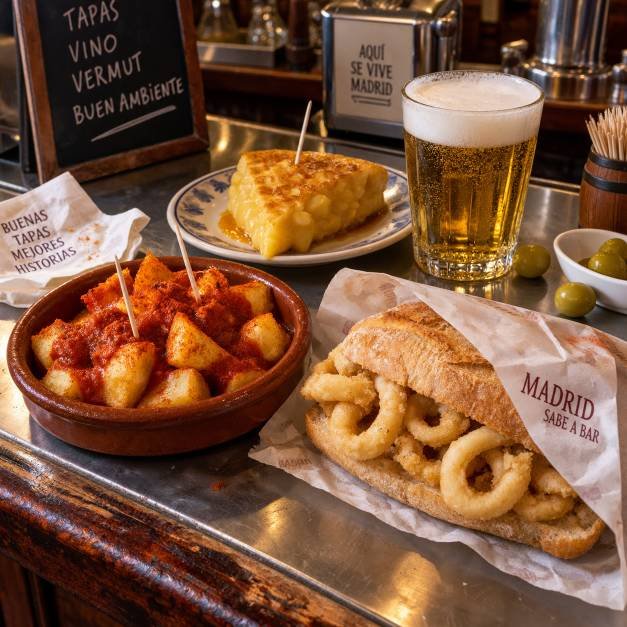
What it is and what to expect: The most emblematic fast food of Madrid’s historic centre. Floured rings of squid are fried in clean oil and served inside a crusty bread roll. Traditionally, it contains only bread and squid, although lemon, alioli or mayonnaise are now commonly available as extras.
Where to enjoy it:
🚇⭐ Bar La Campana (Calle de Botoneras, 6 – Plaza Mayor/Austrias): The epicentre of Madrid’s fried-calamari scene, with constant activity, continuous frying and tender squid. There is usually a queue, but it moves quickly: people take their sandwich and move on rather than lingering.
🚇⭐ Casa Rúa (Calle de Ciudad Rodrigo, 3 – Plaza Mayor): A narrow traditional tavern that competes head-to-head with La Campana for the best classic batter in the area.
🚇⭐ Cervecería Plaza Mayor 2 (Plaza Mayor, 2 – Austrias): A classic spot to order a sandwich at the bar and eat it in the sunshine in the square itself.
🚇⭐ El Brillante (Plaza del Emperador Carlos V, 8 – Atocha): An icon opposite Atocha station, serving large sandwiches quickly along its exceptionally long stainless-steel counter.
Los Bocadillos (Calle del Marqués de Urquijo, 27 – Argüelles): Outside the main tourist circuit and a reference point in western Madrid for its crisp bread and grease-free frying.
Practical tip: Order it para llevar — to take away — at the bar, then eat it sitting on one of the granite benches in Plaza Mayor.
Patatas Bravas (spicy potatoes)
What it is and what to expect: Irregularly cut potatoes fried until crisp outside and tender inside. Traditional Madrid-style salsa brava contains neither tomato nor mayonnaise; it is made with meat or ham stock, oil, flour and a mixture of sweet and hot pimentón de la Vera.
Where to enjoy them:
🚇⭐ Cervecería Gonmar (Paseo de Muñoz Grandes, 47 – Carabanchel/Vista Alegre): Right in the neighbourhood. It serves exemplary bravas, with potatoes softened gently before being finished over high heat and covered with a homemade sauce offering a well-balanced kick.
🚇⭐ Las Bravas (Pasaje de Álvarez Gato/Callejón del Gato, 3 – Huertas/Sol): The historic venue that registered the sauce’s patent in 1960. It is also famous for the concave and convex mirrors associated with Valle-Inclán on its façade. There are several venues with the same name in the centre; they all belong to the same chain and follow the same standard.
Docamar (Plaza de Candelaria, 2 – Quintana): Considered by critics and the public alike to be the queen of Madrid’s salsa brava since 1963.
🚇⭐ Bodega La Ardosa (Calle de Colón, 13 – Malasaña): Rustic-cut potatoes with a thick, richly bound paprika sauce.
🚇⭐ Taberna Sanlúcar (Calle de San Bruno, 4 – La Latina): Gently softened and browned potatoes with a powerful sauce that honours the traditional recipe.
Huevos Rotos o Estrellados (broken eggs)
What it is and what to expect: A base of thinly sliced potatoes, slowly softened in olive oil and finished over high heat. Fried eggs with soft yolks are placed on top and broken with cutlery just before eating, allowing the yolk to coat the potatoes. They are usually served with acorn-fed Iberian ham or chistorra, a thin, highly seasoned sausage.
Where to enjoy them:
🚇⭐ Taberna Los Huevos de Lucio (Calle Cava Baja, 30 – La Latina): The more affordable and informal tavern format from the Lucio family, but just as delicious. Do not confuse it with the historic Casa Lucio, almost directly opposite, which is a considerably more formal and expensive restaurant.
🚇⭐ Taberna Almendro 13 (Calle del Almendro, 13 – La Latina): Rustic and informal, with excellent huevos estrellados served alongside its famous roscas.
Taberna Pedraza (Calle de Recoletos, 4 – Retiro/Salamanca): Free-range eggs and patata agria, a yellow-fleshed potato variety; a refined version of exceptional purity.
Practical tip: This is a dish designed exclusively for sharing in the middle of the table. Do not order it as an individual main course unless you intend to eat nothing else, as the portion is usually generous. In Spain, dishes are shared for a reason — do the same.
Soldaditos de Pavía (fried battered cod)
What it is and what to expect: Pieces of salt cod, coated in a light, crisp batter made with flour and sometimes saffron or beer, then fried in olive oil at high temperature. The fish remains juicy, with delicate white flakes, and is often topped with a strip of roasted red pepper.
Where to enjoy them:
🚇⭐ Casa Labra (Calle de Tetuán, 12 – Sol): Founded in 1860. The queue outside to order a piece of battered cod and a croquette at the wooden counter is a Madrid ritual.
🚇⭐ Casa Revuelta (Calle de Latoneros, 3 – Puerta Cerrada/La Latina): A benchmark for battered cod, with crisp coating and juicy cod that falls apart effortlessly. In my view, these are the best I know.
🚇⭐ Bodegas Ricla (Calle de Cava Baja, 6 – La Latina): A 1910 tavern with traditional earthenware wine jars, where the soldaditos pair beautifully with a glass of draught vermouth.
🚇⭐ Taberna Antonio Sánchez (Calle del Mesón de Paredes, 13 – Lavapiés/Tirso de Molina): Madrid’s oldest unrestored tavern, dating from 1787. Eating battered cod and torrijas here feels like travelling two centuries back in time.
Practical tip: They are ordered individually at the bar. The classic pairing is a cold small draft beer or draught vermouth served over ice with an olive.
Croquetas Caseras (homemade croquettes)
What it is and what to expect: Unlike croquettes in many other countries, Spanish croquettes are a highly refined pan-cooked preparation based on a roux of butter or oil, flour and infused milk — a béchamel sauce — traditionally enriched with Iberian ham, leftover cocido or cod. The outside should be thin and extremely crisp; the inside should be an almost liquid, fluid and silky cream.
Where to enjoy them:
🚇⭐ Casa Labra (Calle de Tetuán, 12 – Sol): In addition to its battered cod, its cod croquette — creamy, with just the right touch of parsley — is a living piece of Madrid history. Order it directly at the wooden serving window.
🚇⭐ Bodega La Ardosa (Calle de Colón, 13 – Malasaña): Its Iberian-ham and cured-beef croquettes have a dense, flavoursome, classic béchamel that has been winning over Malasaña for decades.
🚇⭐ Santerra Neotaberna (Calle de Ponzano, 62 – Chamberí, or at its bar on Calle de General Pardiñas, 56 – Salamanca): Miguel Carretero makes what is widely regarded as Spain’s champion croquette. It has an airy béchamel, an exceptionally precise coating of fine panko and an outstanding Iberian-ham flavour.
🚇⭐ Pez Tortilla (Calle Cava Baja, 42 – La Latina, and Calle del Pez, 36 – Malasaña): Known for both its tortillas and its handmade croquettes with an almost liquid béchamel, always served freshly made and crisp. The menu includes classic combinations such as Iberian ham and cured beef, as well as bolder options such as boletus mushrooms, blue cheese and txangurro — Basque-style spider crab. They are ideal for ordering individually at the bar with a good craft beer.
Casa Julio (Calle de la Madera, 37 – Malasaña): A tiny tavern with red tiles where members of U2 themselves reportedly went to eat croquettes. It is known for its variety — spinach with cheese, blood sausage and ham — and its bohemian atmosphere.
Practical tip: Croquettes come straight from the fryer and retain a great deal of heat inside. Wait a minute before taking the first bite so you can appreciate their fluid texture without burning yourself. They can be ordered individually at the bar or as portions to share.